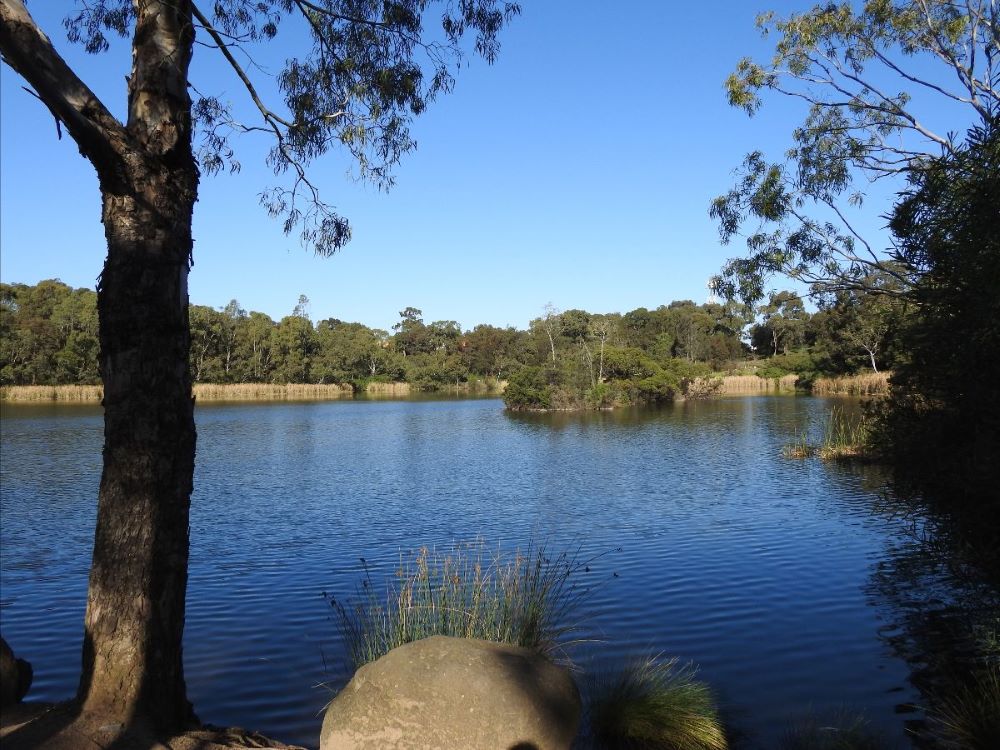
Newport Lakes (Photo courtesy of Suzette Rodoreda, Conservation Ranger, Hobsons Bay City Council)
Have you ever noticed yourself feel better after walking through your local park, drinking your morning coffee in the garden or when you dig a hole to plant something and smell the sweet, alive aroma of the earth?
Most of us do…………………..
Human beings have always been part of nature on this planet and as a species, we have often understood how our connection to nature influences our personal, cultural and economic health. For better or worse, industrialisation, population growth and urban development have disconnected us from nature, especially in the developed West. In response to this there has been growing study of the human-nature relationship from across the life, environmental and social sciences. The learnings from this work are being used to argue for why we should restore this relationship.
Of course, we in the industrialised West are coming to this study relatively late. Indigenous cultures everywhere have regarded the land as sacred; the natural world as intrinsically healing and have often believed our humanity is partly defined by our relationship with the earth. As I write this article in March it is Luk, Eel Season to the Wurundjeri Woi Wurrung people, named so because it is a time when the Yarra River becomes more muddy and the Short-finned Eels migrate downstream toward the sea. Indigenous Australians have the wisdom to observe, understand and live in harmony with their ecologies and this is one reason for their extra-ordinary longevity as a peoples.
During the past few decades’ studies have repeatedly shown that human-beings have higher wellbeing when they have access to and feel connected to, nature. This has led to the creation of an internationally-recognised discipline called Therapeutic Horticulture. Therapeutic Horticulture is a ‘process in which plants and gardening activities are used to improve the body, mind and spirit of people of all ages, backgrounds and abilities’ (Therapeutic Horticulture Australia, 2024). The facilitator of Therapeutic Horticulture activities aims to promote people’s engagement with nature for physical, psychological, social and spiritual enrichment.
Therapeutic Horticulture emerged from many philosophical traditions. These describe how all life is based upon the interdependence of living organisms and the non-living environment (Gaia Theory), how understanding our place in the web of life is necessary for wellbeing (Deep Ecology) and how the future of the planet may rest upon the degree to which human beings can accept nature as an equal (Eco Feminism).
Does all this sound a long way from your day-to-day experience? Are you thinking “I don’t even know what Therapeutic Horticulture would look like? “
You might be surprised to know that you or your family are probably involved in some Therapeutic Horticulture activities already…………..
Common examples include Bush Kindergartens, Kitchen Garden Programs in schools, Bush Regeneration Programs run by Councils, Gardening Programs in Residential Aged Care Facilities and Meditation Gardens in Hospitals. Another example you may have heard of is Shinrin-yoku or Forest Bathing.
Forest Bathing was developed in the 1980s in Japan by Dr. Qing Li. Forest Bathing involves being in a forest or the bush, focusing your attention on the present moment and tuning-in to the sensory experiences (eg the sound of birds singing, fragrance of a eucalypt, the feel of bark peeling on a tree trunk). Dr. Qing Li’s studies have shown that that this mindful presence in nature is associated with reduced blood pressure (hypertension) and stress-hormones (cortisol), and improved concentration and memory-recall. Further, his studies have shown that a chemical released by trees and plants called phytoncides, appears to strengthen the immune system. Dr. Qing Li now leads the Forest Bathing Institute which is dedicated to the scientific study of Forest Bathing.
One last point – Therapeutic Horticulture is different from Horticultural Therapy, in which gardening activities are used by a professional therapist such as an Occupational or Diversional Therapist, to help someone with a health condition recover or build capacity in specific skills identified in a treatment plan. For example, Horticultural Therapy activities such as digging soil or potting seedlings may be used in a Rehabilitation Hospital to help someone recovering from a stroke, regain fine-motor strength. Horticultural Therapy is a very valuable rehabilitation tool, allied to yet different from, Therapeutic Horticulture.
MindEcology sits within beautiful gardens including sensory, fruit and productive plantings, Indigenous trees and grasses, a small pond and is visited by Wattle Birds, Blue-banded Bees and other fauna. There are places to sit, observe, explore, dig and plant.
So if you are feeling exhausted by life in the urban jungle and are yearning for quiet time around greenery and the earth, Therapeutic Horticulture may be for you……………
Sources
CERES Environmental Park (2020). Introduction to Therapeutic Horticulture. CERES School of Nature and Climate.
Inspiring Victoria (2020). Seasons in the Sky.
https://inspiringvictoria.org.au/2020/08/13/seasons-in-the-sky/
Li. Q (2018). The Art and Science of Forest Bathing. How Trees Can Help You Find Health and Happiness. Viking.
Sherwood, H. (2019). Getting back to nature: How Forest bathing can make us feel better. The Guardian, U.K.
Therapeutic Horticulture Australia – website (2024).