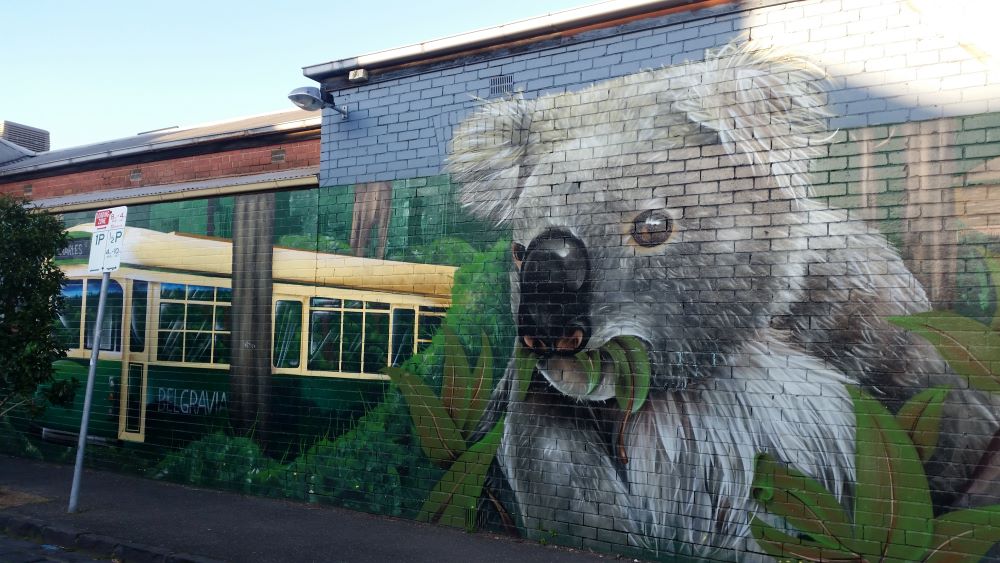
Diverse, Colourful, Gritty, Creative, Vibrant, Evolving………..these are some of the words often used to describe the Western Suburbs of Melbourne. The beautiful mural above which is minutes walk from MindEcology in Seddon, was created by the artist Sugar in 2018 as part of the StreetWorks art project led by the City of Maribyrnong (Untitled by Sugar, Foodworks, Charles St SEDDON – photo by Michelle Earle, 8/8/2022). It captures some of the many ‘faces’ of Seddon as the suburb which was previously named Belgravia, evolved over time.
In it’s early incarnation, the West was vast basalt plains covered by native grasslands, scattered with Sheoaks, Wattles and Banksias; watercourses and swamps. It was home to Kangaroos, Eastern Blue-Tongued Lizards and the Growling Grassfrog. All of this was cared for by the Traditional Custodians of the land.
Then the West evolved. Inner suburbs like Seddon became working-class, industrial centres, due to their proximity to railway lines and the Yarra River for freight transportation. Seddon became a hub for migration, especially from the U.K and Europe. Some outer suburbs like Werribee became a centre for agriculture, with vast market gardens supplying fresh produce for a growing population.
Over time, development in the West proceeded apace with communities stretching from the inner edge in places like Seddon, through Laverton and Deer Park, to a constantly redrawn outer edge. Caroline Springs, one outer West suburb established in 1999, was one of the fastest growing suburbs in Melbourne at that time.
Today, the West is one of the most developed regions in Victoria. Migration has expanded to include the regions of Indo-China, the Middle East, South America, the Horn of Africa and the former Republic of Yugoslavia.
During this time the West has transformed into a vibrant human ecology known for it’s working-class roots, cultural and linguistic diversity, dynamic arts and cultural festivals, great sporting clubs, for it’s young families, multigenerational families, and for it’s sense of community.
But transformation in the West over time has bought other, less welcome impacts.
The natural environment of the West has been completely altered. Today, there are only tiny remnant grasslands left and these are endangered. At the inner edge within the City of Maribyrnong where Seddon sits, only 10% of the total land area is green or open space and there is only 7.4% tree canopy cover. In the outer edge of the West the impact is greater; there is only 6.3% tree canopy cover in the City of Melton where Caroline Springs sits, and only 3.1% in the City of Wyndham where Werribee is located.
Human health and wellbeing in the West also show signs of transformational strain. In the City of Maribyrnong alone during 2017, 23% of adults reported their health status was fair or poor and 26% of adults reported low or medium life-satisfaction. Further, 18% reported experiencing high or very high psychological distress and 17% had sought professional help for a mental health problem.
In the face of present-day, lived experience of the way changes in the natural world can parallel diminishing human health and wellbeing, what can we do to improve outcomes for all?
The Traditional Custodians of the land continue to care for Country and have wisdom to offer us here. For example, the Wurundjeri Woi-Wurrung Cultural Heritage Aboriginal Corporation, one leading voice regarding local cultural resource management, joined with the Victorian State Government in 2017 to launch the Yarra River Action Plan. The Plan included the creation of the Birrarung Council, comprising Traditional Owners and stakeholders from community, environmental and farming groups to provide independent advice to the Victorian Government about the stewardship of the Yarra River. The Plan also established controls to protect the Yarra River from further development and overshadowing. This has set the scene for rehabilitation of stretches of the river by various Local Government, environmental and community groups. The Maribyrnong River, which snakes through the West from the North, joins the Yarra River at Yarraville next to Seddon before emptying into Port Phillip Bay.
At MindEcology we acknowledge the Traditional Custodians of the land on which we are situated, the Wurundjeri Woi-Warrung and Boonwarrung people of the Kulin Nation, and we pay our respects to their Elders, past, present and emerging. We recognise their continuing connection with the land.
Our mission at MindEcology is to support people living, working, studying or playing in the Western suburbs to improve their health and wellbeing, in two ways.
Drawing upon the power of reaching out, talking, listening, honouring and growing through lived experience, we offer high quality Clinical Psychology Assessment and Therapy for individuals, couples and groups who are experiencing the struggles of living, or who are living with mental health difficulties.
Further, we offer Therapeutic Horticulture or Gardening services geared toward helping people strengthen their connection with nature by listening to the bush, getting their hands in the earth, planting seeds and if they choose, participating in community gardening or environmental restoration projects.
If this resonates with you please become part of the MindEcology community by following our blog posts over time as they explore these issues and services further, alert readers to important dates in the calendar or coming events, and to community projects you may wish to be part of.
We look forward to sharing the journey with you as we shape the West further together………….
Sources
Australian Bureau of Statistics (2021). Census of Population and Housing.
Australian Plants Society, Keilor Plains Group Inc. (2021). Plants of Melbourne’s Western Plains: A Gardeners Guide to the original flora (2nd Ed.).
Maribyrnong City Council. (2020). City of Maribyrnong Health and Wellbeing Data Book.
Maribyrnong City Council. (2022). The History of Footscray and Surrounds.
Wikipedia (2022). Caroline Springs, Victoria.
Wikipedia (2022). Seddon, Victoria.
Wikipedia (2022). Werribee, Victoria.
Wurundjeri Woi-Wurrung Cultural Heritage Aboriginal Corporation – website.